The Dependency Rule
The long-term health, adaptability, and possibly the viability of a project relies on sound management of dependencies. A mess of spaghetti-like interdependencies will occur if developers create classes that reference each other without careful consideration, which can seriously affect a team's ability to deliver business value in a consistent, predictable fashion. (McLean Hall, Gary)
Policy and Details
All software systems can be decomposed into two major elements: policy and details. (2017 Martin 140)
The policy element embodies all the business rules. The policy is where the true value of the system lives. The policy should have no knowledge of the details and does not depend on the details in any way.
The details are those things that are necessary to enable humans, other systems, and programmers to communicate with the policy, but that does not impact the behavior of the policy at all. They include IO devices, databases, web systems, servers, frameworks, GUI, communication protocols, and so forth.
Business Rules
Business rules are rules or procedures that make or save the business money.
Some business rules are considered Critical Business Rules and are critical to the business itself and would exist even if there were no system to automate them. The fact that a bank charges N% interest for a loan is a business rule that makes the bank money.
Other business rules may be closely tied to the application, or they may be more general. For example, the validation of input fields is a business rule that is closely tied to the application itself.
Separating Business Rules (Critical vs. Application Specific)
These two different kinds of rules (Critical Business Rules and Application Specific Business Rules) will change at different rates, and for different reasons—so they should be separated so that they can be independently changed. See SRP (2017 Martin 190)
Entities: Critical Business Rules
An Entity is a class that contains a small set of critical business rules operating on Critical Business Data. Loan, for example:
Use Cases: Application-Specific Business Rules
Use cases specifies the input to be provided by the user, the output to be returned to the user, and the processing steps involved in producing that output.
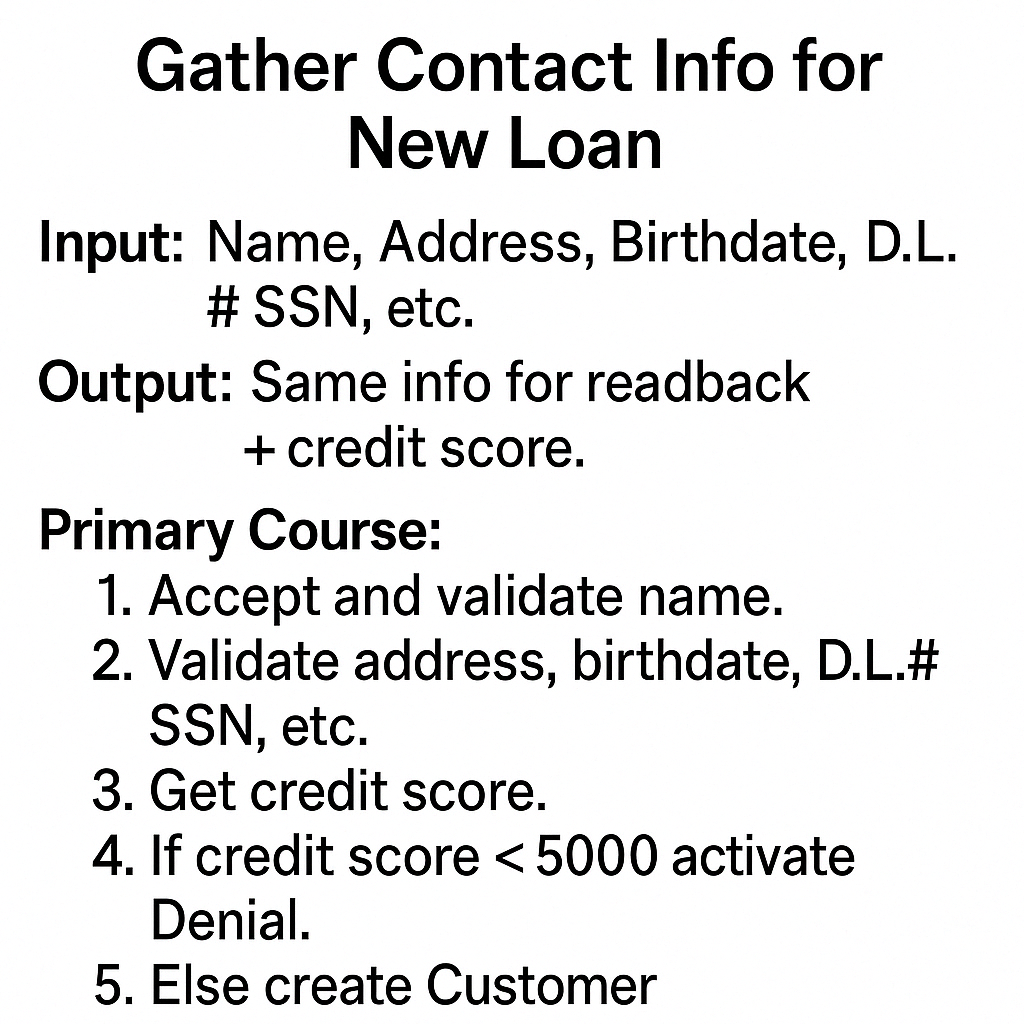
Relationship Between Entities and Use Cases
Entities classes are at a higher level than classes that implement use cases.
Why? Because use cases are specific to a single application and, therefore, are closer to the inputs and outputs of that system. Entities are generalizations that can be used in many different applications, so they are farther from the inputs and outputs of the system. Use cases depend on Entities; Entities do not depend on use cases. (2017 Martin 193)
Levels and Change Rate (SRP)
Policies that change for the same reasons, and at the same time, are at the same level. Policies that change for different reasons, or at different times, are at different levels. see Single Responsibility Principle (SRP)
Details Depend on Policies
The code that implements high-level (HL) policy should not depend on the code that implements low-level (LL) details. Rather, details should depend on policies.
Dependency Notation
Here we are letting a simple arrow ⟶ represent any type of dependency and we represent inheritance with the open arrow ─▷.
The reason for the distinction is that inheritance is the strongest, and most rigid, of all the source code relationships; consequently, it should be used with great care. (2017 Martin 88)
The Problem with Dependencies
For a class, its dependencies include all the modules on which each of its elements depends. The key problem with dependencies is that a module may break whenever one of its dependent modules has changed. Here, change is not only about the syntax but also the semantics of the coupled modules. (Dianxiang Xu 89)
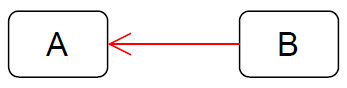
Organizing Levels and Dependencies
Where to put items that belong to the same level?
Small to Medium Applications
folders or namespaces.
Larger Applications
Components (assemblies in .NET) are the units of deployment.
Java- .jar files; .NET - .dll; c++ .lib, .dll, ...
Can be linked together into a single executable. Or they can be aggregated together into a single archive, such as a .war file.
Can be independently deployed as separate dynamically loaded plugins, such as .jar or .dll or .exe files.
The Dependency Rule (Formal Statement)
Source code dependencies must point only toward higher-level (HL) software artifacts (classes, modules, components, etc.).

That includes functions, classes, variables, or any other software artifact.
Data Formats (
DTOetc.) declared in LL code should not be used by HL code, especially if those formats are generated by a framework in the LL (database models). We don't want anything in the LL code to impact the HL.Data that crosses the boundaries should be simple data structures. (Structs or DTOs)
Don't pass Entity objects or database rows.
When passing data across a boundary, it is always in the form that is most convenient for the HL module.
High-Level Invisibility of Low-Level Details
Nothing at a HL can know anything at all about something in a lower level (LL).
Name Restrictions
The name of something declared in LL code must not be mentioned in HL code.
Handling Flow of Control (Dependency Inversion)
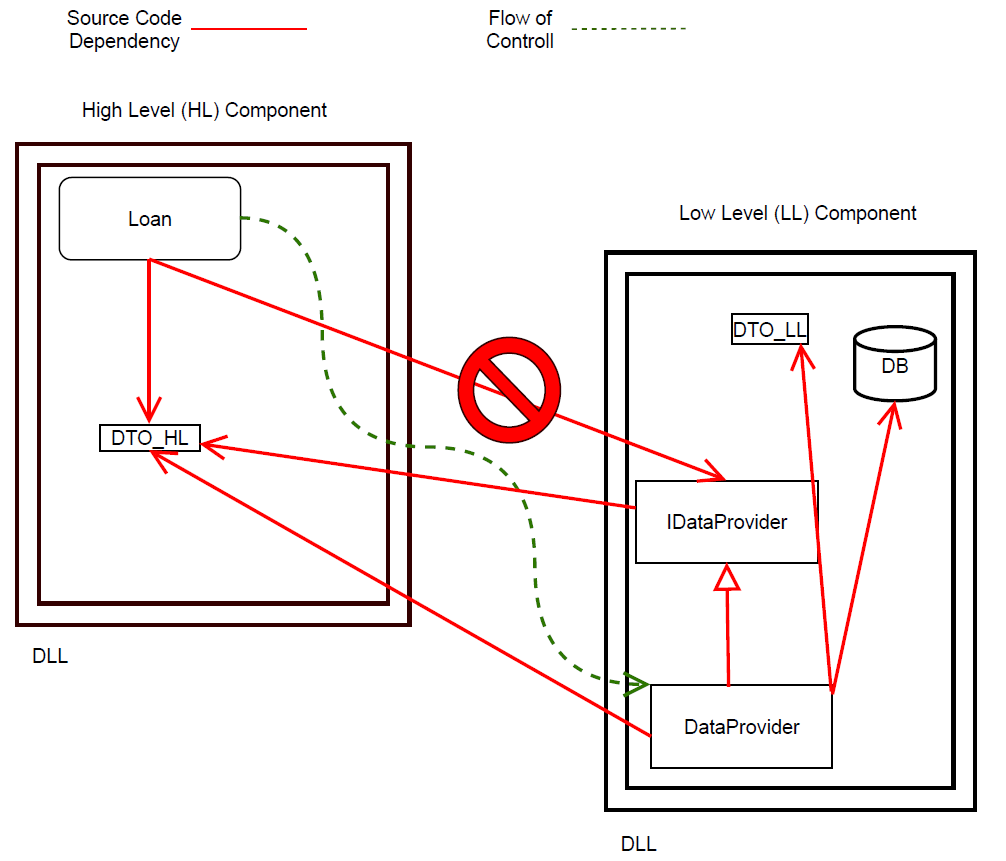
Suppose something in a HL module (namespace or component) needs to call (flow of control) something in a LL module. 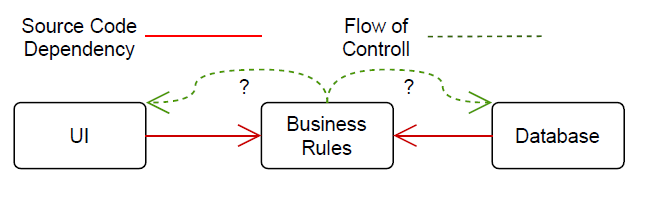
This call must not be direct because that would violate the Dependency Rule. See Dependency Inversion Principle (DIP)
Instead have the HL code call an interface that the LL code implements.
Also, the interface must be declared in the HL module.
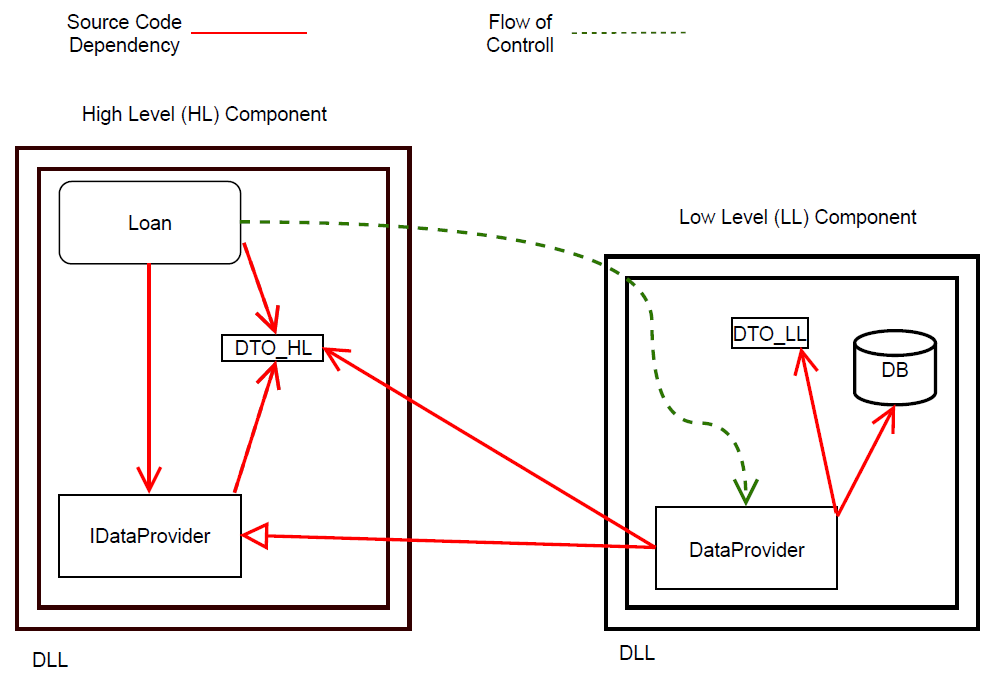
The HL component is calling the DataProvider via the IDataProvider interface. Notice that whenever a dependency arrow crosses the border of a component the direction is always in the direction of LL to HL.
See Also:
Single Responsibility Principle (SRP) (related to levels/change rate)
Big Ball of Mud (result of violating dependency rules)
Inheritance (mentioned as strongest dependency)
DTO - Data Transfer Object (used for boundary crossing)