Motivation for Good Design
The second law of thermodynamics, in principle, states that a closed system's disorder cannot be reduced; it can only increase or possibly remain unchanged. A measure of this disorder is entropy. This law also seems plausible for software systems: a system's disorder, or entropy, always increases. We can call this software entropy. (Jacobson 69)
To use a physics analogy, software systems model complex systems, which tend toward entropy (or disorder). Energy must be added to a physical system to preserve order. The same is true for software systems: architects must constantly expend energy to ensure good structural soundness, which will not happen by accident. (Mark Richards and Neal Ford)
An Entropy Analogy: The Bag of Bricks
This tendency towards disorder can be visualized with a simple analogy: dump a bag of bricks, and you'll get a pile, not a wall. Why? Because there are vastly more ways for bricks to be arranged in a disordered pile (a high-entropy state) than in the precise structure of a wall (a low-entropy state). Randomness favors disorder simply due to probability.


Software is similar. Without the deliberate energy spent on applying design principles and refactoring (like carefully stacking bricks), code naturally drifts towards complexity and disorganization (the pile). There are far more ways to write messy code than clean code. Achieving and maintaining a low-entropy, well-designed system requires continuous, conscious effort; it doesn't happen by chance.
See High Complexity for example code that is high in entropy.
A program that is used will be modified. When a program is modified, its complexity (entropy) will increase, provided that one does not actively work against this. (Jacobson 69,70)
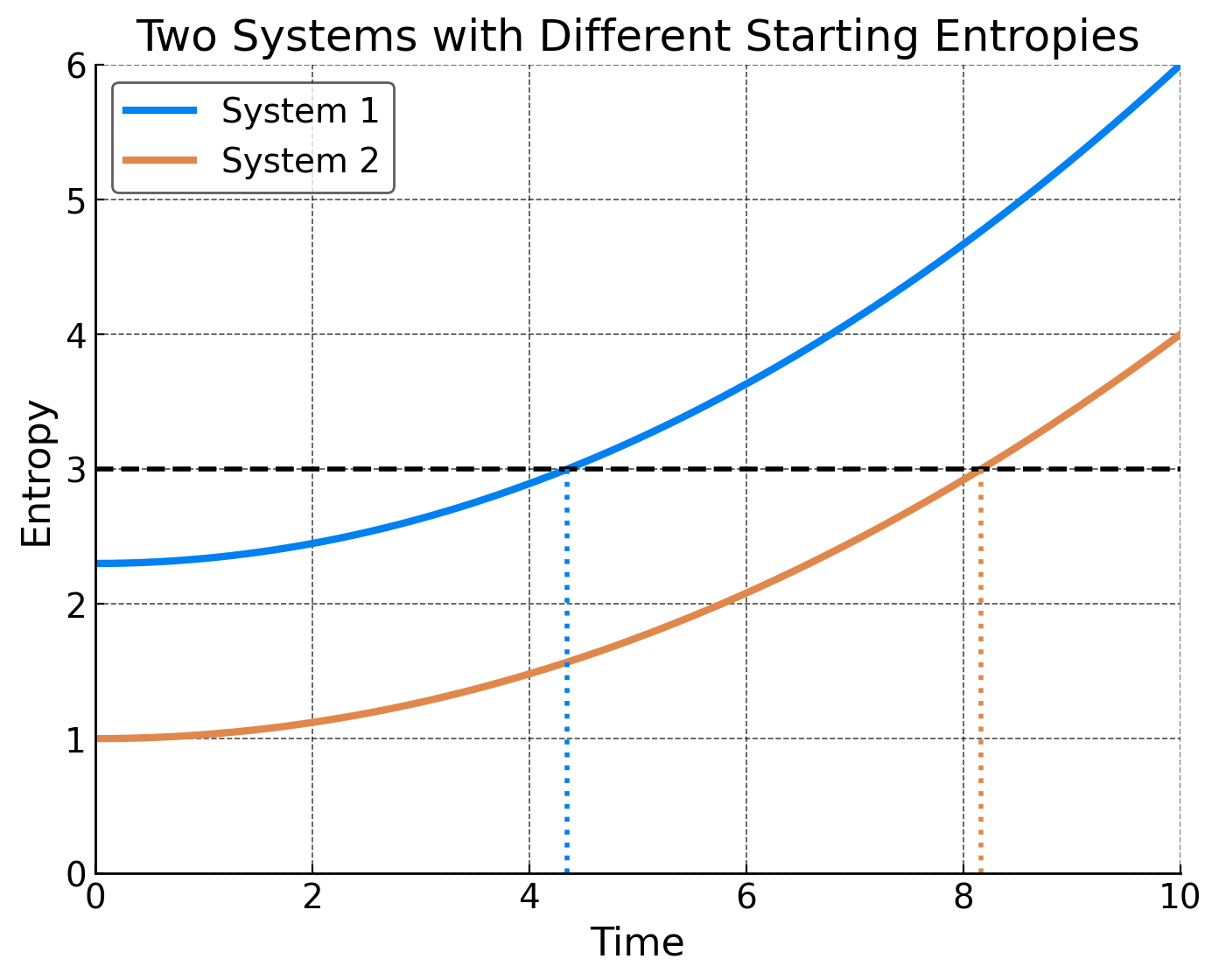
Assume that a system initially has a certain software entropy. Experience shows that it is reasonable to assume that the increase in software entropy is proportional to the entropy of the software when the modification started. This means that it is easier to change an ordered system than a disordered one—something that all experience shows. (Jacobson 69,70)
When we design a system with the intention of it being maintainable, we try to give it the lowest software entropy possible from the beginning. This is one of the aims of system development. (Jacobson 69,70)
The Law of Change (Max Kanat-Alexander)
The longer your program exists, the more probable it is that any piece of it will have to change.
Your software has to change, but changing it will introduce defects.
The chance of introducing a defect into your program is proportional to the size of the changes you make to it.
This is why we need good design.
The best design is the one that allows for the most change in the environment with the least change in the software.
It is important to design for evolution, to structure a program to evolve through changes in requirements and technology. (Coplien 189)
See Also:
Big Ball of Mud (consequence of poor design/entropy)